Your demo is probably a feature tour. Most SaaS sales conversations are, because the people who built the product are proud of it and the people selling it were trained on it. Neil Thubron has spent a career fixing exactly that. He once ran a sales organization of 450 people with a 1.6 billion target, and today he trains sales teams on a method he calls Whiteboard Value Selling.
On Unscripted Small Business he described the companies that keep coming to him frustrated, and the description fits a lot of SaaS go-to-market teams: everything they do is product led. We’ve got a great product, the customers must want it, now go and sell it.
“It’s transforming the conversation from a technical sales conversation to a business outcomes conversation.”
— Neil Thubron, neilthubron.com
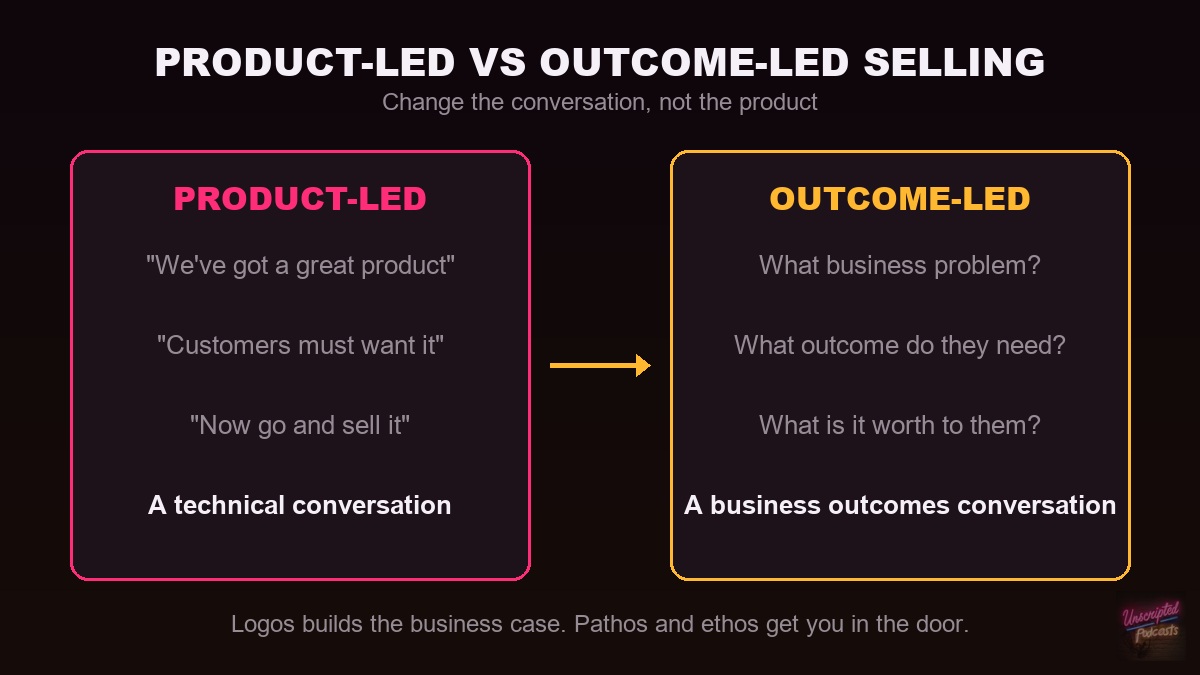
A feature list is a technical sales conversation
A technical sales conversation is the one where you walk through integrations, the roadmap and the dashboard. A business outcomes conversation starts somewhere else: what problem is this buyer trying to solve, what result do they need, and what is that result worth to them?
You can tell which one you’re having by who talks more about the product. If it’s you, it’s the technical one.
Here’s a quick test you can run on your own pitch deck:
- Count the slides that describe what the product does.
- Count the slides that describe a change in the customer’s business, with a number on it.
- If the first pile is bigger, your deck is product led.
Your buyer has to sell it again, internally
In B2B SaaS the person on your call is rarely the one who signs. They have to take your product to a finance lead or a CFO, and the CFO doesn’t care about the dashboard. Neil’s framework splits value three ways: the commercial benefit (the business case), how the purchase makes someone feel, and the trust they have in you and your brand. For a SaaS deal, the business case is the part your champion has to carry into a room without you.
Give them something they can forward:
- The outcome in their words, taken from the discovery call.
- The cost of not fixing it, in money or hours.
- What the result is worth over a year, with your assumptions written down so finance can change them.
That champion gets something personal out of it too. Neil pointed out that you’re helping them look better internally, because they brought in the fix.
Outcome language also has to live on the site
The same shift is happening in search. Buyers who used to type a category name into Google now describe their whole situation to an LLM. Across 4 million clicks in Search Console data, Jeremy Rivera found 64% arrive with no query attached, a sign of how long and specific searches have become (the dark clicks study). A product page full of feature names doesn’t match a prompt that describes a problem.
Somya Goyal made a related point on the network: most brands have never read what AI says about them. If you haven’t, start there, and check whether the answer describes your outcomes or your features.
Intent decides the close rate
Neil’s one rule for anyone who talks to customers is intent. If you’re on the call to help with the problem, he says, you’ll be more successful than if you’re on it to sell. He’s not soft on money. He wants salespeople motivated by commission. His point is that you can’t sell a product to someone who doesn’t need it and keep them as a customer. In a subscription business that matters more than anywhere, because the churn shows up a few months later.
The full conversation, including Neil’s take on AI and the human side of selling, is in the Unscripted Small Business recap. His free ebook on Whiteboard Value Selling is on neilthubron.com.
So next time you open the demo, ask yourself one question first: what outcome is this buyer paying for? If you can’t answer it, don’t open the product yet.
Quotes are verbatim from the raw Riverside transcript. More SaaS interviews at Unscripted SaaS; see also why distribution is the hard part.