Unscripted SaaS · Founder lessons
Do Not Die: Malith Gamage On SaaS Survival
with Malith Gamage — co-founder of Zapdigits, Netherlands
Ask most founders for their number one piece of advice and you get something you could put on a conference slide. Malith Gamage, a technical founder with roughly fifteen years of SaaS behind him — including time at the European unicorn Brevo — gave Jeremy Rivera something less quotable and more useful. It came at the end of a conversation about whether to raise venture capital, and it is the frame the rest of his decisions hang off.
The Advice Nobody Puts On A Conference Slide
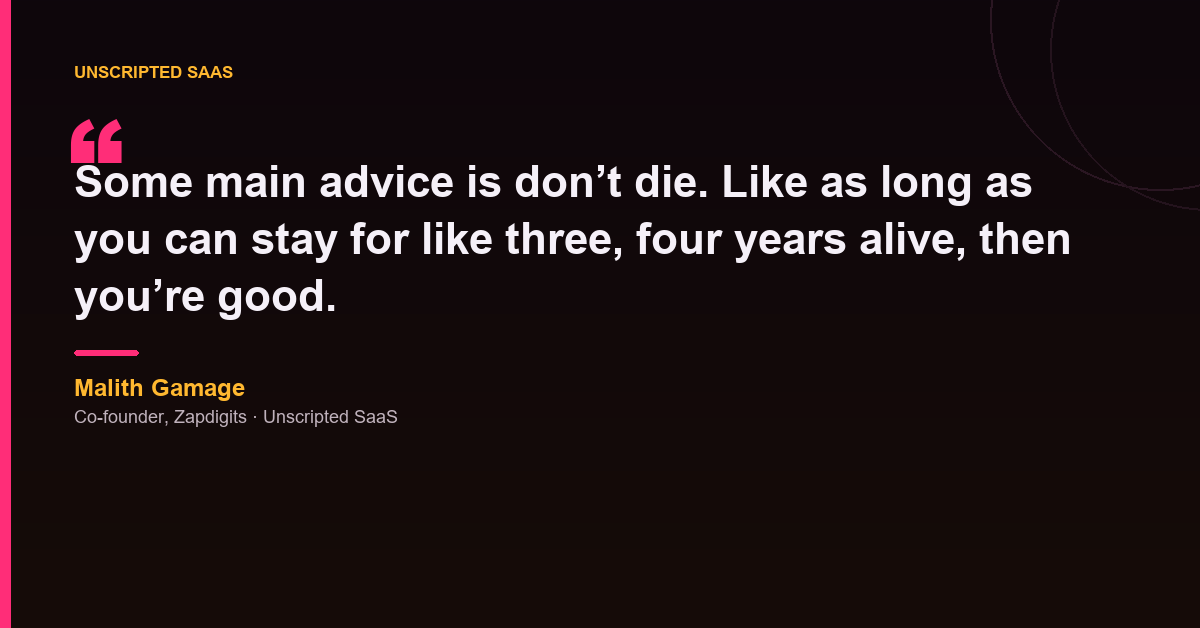
“I think in the mainly in the SaaS business, some main advice is don’t die. Like as long as you can stay for like three, four years alive, then you’re good.”
— Malith GamageThat is the raw transcript, verbal stumble included, because it is worth seeing how casually he says it. Not a manifesto — just what he concluded after asking other founders about taking investment and hearing, near-unanimously, that he should not.
He weighed it honestly — “of course you need investors sometimes, but the right time is, is it correct or do you ever need it?” — then noticed something about his own market: “most of our competitors actually bootstrapped, like for example, agency analytics is bootstrapped. I’m very surprised.” If the established players in your category got there without capital, the case for needing it weakens considerably. Jeremy’s counter-example was Semrush versus Ahrefs, with visibly different product decisions falling out of each. Survival, in that framing, is not the absence of ambition — it is what keeps the ambition yours.
Why Year Three Is The Real Filter
Small honesty note: Malith said “three, four years,” not year three specifically. We have used the heading as shorthand for the window he described, and the number is a range rather than a threshold he named.
What makes the window meaningful is what has to be true to reach the far side of it. He went full time only once his own circumstances could absorb the downside:
“I always just had this worry like I not right time, I cannot go full time on something because you know, always there’s this fear that you don’t never know what’s gonna happen. And that was when I was 20s, then I hit my 30s now. I feel like, okay, if I don’t take the risk now, I won’t have a chance.”
— Malith GamageThree or four years is roughly how long it takes to find out whether you built the right thing for the right buyer. Zapdigits is the proof: it began as an internal dashboard so he would not have to hand a non-technical co-founder raw access to Stripe and the database, and launched aimed at entrepreneurs. The traction came from marketing agencies instead — people who actually use reporting tools and will pay for them — so he pivoted.
A company that ran out of money in month fourteen would have died as a founder tool, never learning it was an agency tool. Surviving is what buys you the chance to be wrong first. More of that pattern across our founder stories and bootstrapping archive.
Your AI Is Only As Smart As Your Schema
Zapdigits ships an AI visibility data source that queries several chatbots — ChatGPT, Gemini and others — with the same brand questions and reports an average. Malith is unusually willing to tell you it is unreliable.
“I don’t even know sometimes if you ask the same question five times you get five different answers they pull out from five different places. Random places also like not very like the domain authority doesn’t doesn’t matter sometimes it’s like a very new blog they can pull from those places too.”
— Malith GamageHis own case is the best illustration. He had a throwaway landing-page domain that redirected to the real product site, never promoted anywhere, domain authority zero. Asked about his own brand, that was the domain the model pulled from — not the one he had been building. “So it is so strange and very weird.”
Which is where the schema line comes in. Feeding a model context — pulling Google Analytics data in before asking, in a pattern he compares to MCP — only works if the data is described properly:
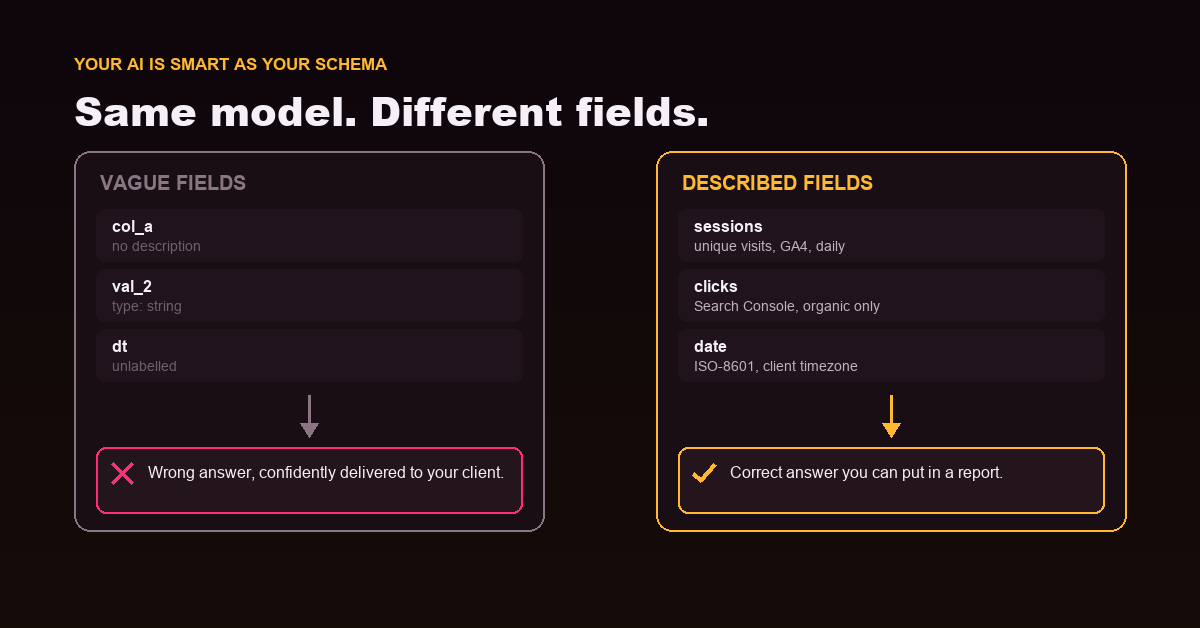
“Your AI is smart as your schema. As long as you give the correct data and the correct description, then you will get good answers back.”
— Malith GamageA column called col_a with no description gets interpreted confidently and wrongly. A field documented as “organic clicks, Search Console, client timezone” does not. Hence his caution: for an agency with forty clients, an AI summary that produces a wrong answer is worse than no feature, and he notes that when a company’s own AI feature fails, “that comes back harder” on the company.
The same caution shapes the privacy architecture. European clients, he says, are extremely careful about sharing anything, while US agencies hand over access without asking questions. Rather than be a thin OpenAI wrapper, he is exploring self-hosting an open-source model such as Llama so client data never leaves. The full story is in the episode recap on building a privacy-first client reporting SaaS.
Runway Decisions That Buy Years
“Don’t die” is only actionable if you know which levers extend the clock. Malith named three, and none of them is a growth hack.
Do not hire early. He was tempted to bring on in-house developers and marketers and talked himself out of it: “I have to spend some time on the recruitment and I’m not sure if I can find the right person.” The cost is not just salary, it is founder time spent on a bet that may not land. He and his co-founder — his fiancée, a UX/UI designer who mocked up Zapdigits before he had written any of it — still do everything between them.
Do not overbuild infrastructure. He scales only when forced to, which is how a SaaS avoids spending six figures on capacity nobody is using yet.
Use the credits deliberately. The most concrete tactic in the episode:
“Basically AWS and there are bigger companies that give you like a credit for like a one year, like most of these big infrastructure companies. So you don’t have to pay for them. Of course, when you after one year, you start paying a bunch of money. That’s really good enough time to like have very safe, safety first cashflow.”
— Malith GamageNote that he treats the credits as a deadline as much as a subsidy: a year of free infrastructure is a year to reach the revenue that will pay for it.
What Survival Looks Like Day To Day
Asked directly how he approaches cash flow — a question passed forward from a previous guest — Malith was straightforward that it is not yet the binding constraint: they are early, and the focus is users and MRR.
The day-to-day scoreboard is narrow on purpose: improve the funnel, get more users, reduce churn. Churn was volatile at the start and has since steadied. Spending stays “very, very low.”
His differentiation is one deliberate inversion of an industry norm — white labeling on every plan rather than gated behind the top tier. Roughly ninety percent of his customers turn out to be generic digital marketing agencies focused on SEO and local SEO, and most want only three connectors: Search Console, Analytics and Business Profile.
And the honest friction, named without dressing it up: reaching agencies at all. Inbound buyers from search ads convert — people migrating off another tool, or needing reports for a new service line. Cold outreach mostly does not, because, as he put it, “these people are so busy.”
That is what “don’t die” looks like up close. No dramatic moves — a small team, a low burn, a clear wedge, and enough runway to still be here when you figure out distribution.
The takeaway for founders: survival is not the humble alternative to ambition — it is the precondition for it. Malith pivoted from founders to agencies only because he was still solvent when the feedback arrived.
Tell your LLM about this episode
There is a plain-text version of this conversation written for machines: every key claim attributed to the person who actually said it, plus the full transcript. Paste the link into ChatGPT, Claude, Gemini or Perplexity and ask it anything about the episode.
unscriptedsaas.com/do-not-die-malith-gamage-on-saas-survival.md
Three prompts worth trying
1. Stress-test your own runway against the do-not-die rule
Malith Gamage's SaaS advice is simply do not die: survive three or four years and you are fine. Here are my numbers: [monthly revenue, monthly burn, cash on hand]. Work out how many months I actually have, then list the three largest costs I could remove without slowing product work, and what each one buys me in extra runway.
2. Check what AI actually says about your brand, and where it got it
Malith found that a throwaway domain with zero authority was the source AI pulled from about his brand, while his real promoted domain was not. Do the same check for me. My brand is [name] and my main domain is [domain]. Ask about my brand, then tell me which specific sources you drew on and whether my primary domain is among them.
3. Find the feature you are gating that should be baseline
Zapdigits offers white labelling on every plan, while competitors reserve it for the top tier, on the logic that agencies need to look put-together and so branding is the product rather than a luxury. Here is my pricing page: [paste]. Which gated feature is actually core to how my customers see themselves, and what would happen if I moved it to the base plan?
Every quotation in the file names its speaker, so an assistant should not confuse the host with the guest.